
West Virginia Sources for Past Residents
Previous residents of a West Virginia address are found by lining up sources that record different things. A deed index follows land transfers, while directories and census records can place a household near a particular date. There is no single statewide online cutoff for deed images: the Cott or RECORDhub reach is county-specific and appears under Certified Dates. Older West Virginia deed books may sit with a County Clerk, State Archives, or WVU's West Virginia and Regional History Center.
| Record source | Coverage | Where to look | Evidence it adds |
|---|---|---|---|
| West Virginia county deed and index books | County cutoff and image years listed in Certified Dates | County Clerk, Cott, or RECORDhub | Parties, filing date, book/page, legal description, prior reference |
| West Virginia early deed books | Varies by county; Mineral example: books 1-59, 1866-1940 | County Clerk, State Archives, or WVRHC microfilm | Earlier legal chain when an online index ends |
| Charleston, West Virginia city directories | Archives holdings from 1874-75; Polk from 1908 to present | State Archives and Kanawha County Public Library | Dated residence, occupation, and address clues |
| West Virginia WVRHC directory microfilm | Charleston 1906-1988; other city runs vary | WVU West Virginia and Regional History Center | Alphabetic and street context in held years |
| West Virginia federal census records | Released through 1950 under the 72-year rule | National Archives and library databases | Household and address-area context, not title |
| Charleston Sanborn maps, West Virginia | 1884, 1888, 1893, 1897, 1902, 1907, 1912, 1918, 1919, 1922, 1933 | WVU digitized collection | Building footprint, lot, street, and use |
| Charleston, West Virginia permits and code files | Current permit classes; online historical cutoff not posted | Charleston Building Department or local office | Work type and address/date context |
| West Virginia vital and obituary records | Birth/death indexes from 1917; marriage index from 1924 | WVVRR, Archives, newspapers, and libraries | Dates, relatives, and possible final-address clues |
Use the deed chain to establish ownership and the dated household sources to identify who may have lived there. Sanborn maps show buildings, not names. Each county has its own record history, so a missing year should prompt a different repository or index check rather than a statewide assumption.
West Virginia Parcel Trail for Past Residents
Begin with the present parcel, not a remembered street number alone. The WV Property Viewer can search an E-911 address, parcel attributes, map geometry, or coordinates. Its detail panel separates the physical address from owner information and may show deeded acreage, parcel ID, map links, building information, and values where populated.
In West Virginia, the viewer is a statewide locator; county assessment and deed records remain the source trail for a parcel's assessed owner and recorded transfers.
Keep the parcel ID and legal description beside the current assessed owner. A result row may display only one owner even when the detail differs. The mailing address is separate and does not establish who lived at the parcel. Precise address search expects street address, city, and state; if it fails, try the street name in the assessment system. For a current, street-wide record chain, use the West Virginia street directory.
The viewer's search controls include these modes and fields:
| Search control | Type | Required | Notes |
|---|---|---|---|
| West Virginia Property Viewer E-911 address | Text | Optional | Use street address, city, and WV; rural routes and PO boxes do not match. |
| West Virginia Property Viewer parcel attributes | County selector and text fields | Optional | County, owner name, property address, parcel number, or parcel ID parts. |
| West Virginia Property Viewer geometry | Map drawing | Optional | Point, rectangle, or polygon, with optional buffer size. |
| West Virginia Property Viewer coordinates | Latitude and longitude | Optional | Enter both coordinate values. |
| West Virginia Property Viewer controls | Buttons and layer toggles | After criteria | Search, Start Over, Export CSV, View in Map, identify, and layer controls. |
A parcel detail record may include:
- Parcel or GIS ID, county, district, map, parcel, and suffix.
- Owner, physical address, deeded acreage, description, and building information.
- Delinquent status, community, flood data, external map links, and appraised or cost values where populated.
- Parcel, tax-district, address-label, flood, and reference layers; sensitive telephone and alarm fields are redacted.
West Virginia Deed Chain for Previous Residents
The backward deed method is steady across West Virginia even when online coverage varies. Find the assessed owner's purchase as grantee, read the seller and prior reference, then search that seller as a grantee for the earlier transfer. Keep matching the land itself at each step. A person with a similar name is not enough, and one deed can include more than one tract.
- Copy the current owner's name, parcel ID, and legal description from the assessment record.
- Search the County Clerk index for that owner as grantee near the assessment transfer date.
- Compare the deed's grantor, date, book/page or instrument number, prior reference, and land description.
- Search the prior grantor as grantee, then repeat with the next seller or named estate.
- When online coverage stops, check the county record room, deed books, microfilm, or a written clerk request.
The West Virginia County Clerk Portal allows guest index access for participating offices. Image access may require payment, and a county's Certified Dates determine its online span. Some counties have moved to RECORDhub, which may mean checking both systems before calling the search complete.
In West Virginia, check the county's Certified Dates before treating the first online index year as the start of the parcel's ownership history.
Typical Cott index controls include:
| Index field | Type | Required | Notes |
|---|---|---|---|
| West Virginia County Clerk index: type and document kind | Dropdown | Varies | Exact choices depend on county. |
| West Virginia County Clerk index: book, page, suffix | Text | Varies | Reference-based search controls. |
| West Virginia County Clerk index: date range and filing date | Date fields | Varies | Use an approximate recording window when known. |
| West Virginia County Clerk index: grantor, grantee, description | Text | Varies | Search names and land description separately or together as supported. |
| West Virginia County Clerk index: document number and amount | Text or number | Varies | County-index fields differ. |
- Grantor / grantee
- The grantor transfers an interest; the grantee receives it.
- Chain of title
- The linked sequence of recorded transfers for a parcel.
- Legal description
- Land text such as lot and block or metes and bounds, used to identify the tract when a street number shifts.
- Book and page
- The recorded volume and page reference used to find an older instrument.
West Virginia Deed Index for Past Residents
A deed index entry is a path to a recorded document, not the document's whole meaning. Depending on the county, the Cott result can include these fields:
- Filing date, index type, document kind, and instrument or file number.
- Grantor and grantee names, sometimes with trustee, executor, or administrator roles.
- Legal description, subdivision, lot/block, acreage, street or road, and prior book/page reference.
- Amount when supplied, plus an image link or thumbnail where online images are available.
Search both parties when an owner appears in more than one role. When a name search is noisy, use a known book/page or instrument number and compare the land description. W. Va. Code §39-2-2 calls for grantor and grantee names in county indexes, among other indexed parties; trustee or special-commissioner deeds also list the former owner and executing party.
Charleston Sanborn Maps Date a Building
For a Charleston address, Sanborn fire-insurance maps can show how a building and block changed over time. WVU's digitized Charleston Sanborn collection includes sheets from 1884 through 1933, with specific years listed in the West Virginia source table above. These maps can help match a lot or street pattern when an address has shifted.
The map records the structure and land use, not a household or occupant. Pair its footprint with an address directory, census record, and deed before assigning a person to a building. WVU describes remote or in-person access, and the collection has 281 TIFF files.
The digitized collection page shows the linked Charleston map records and their dates.
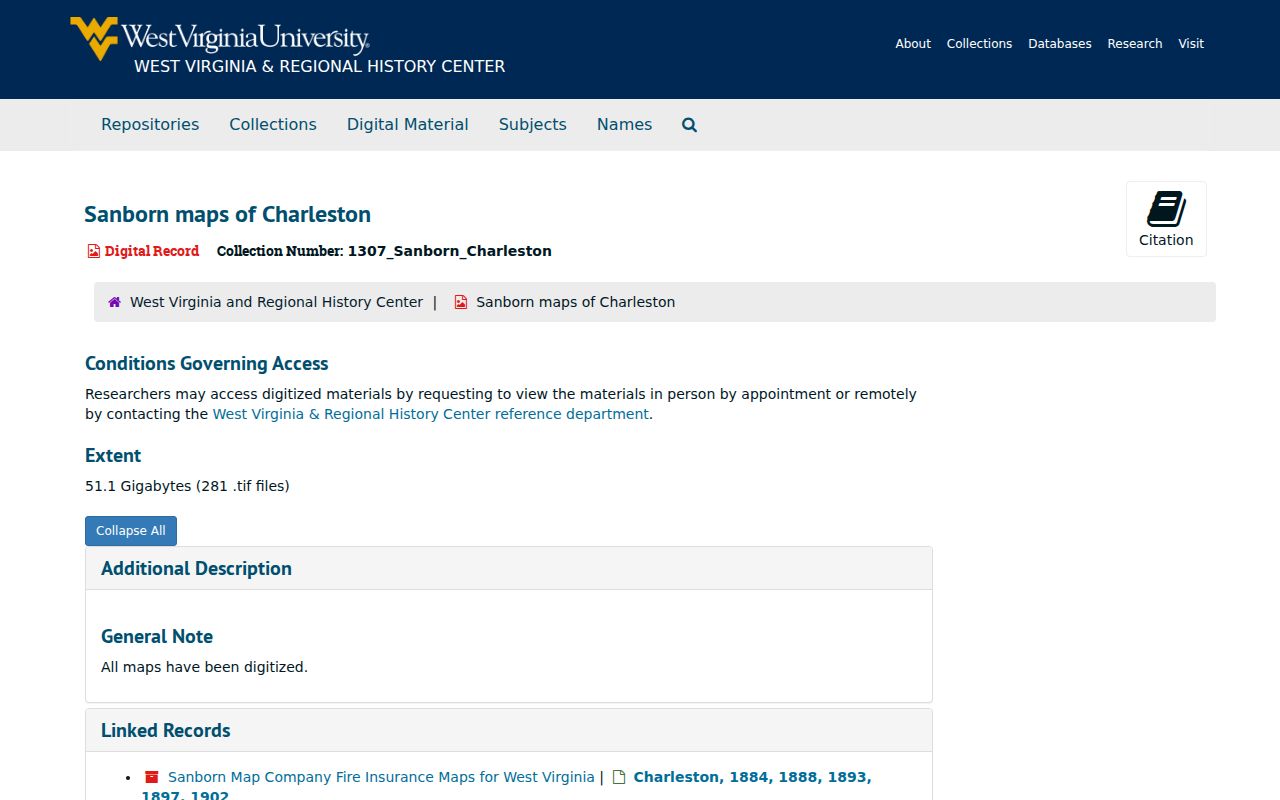
A map can make an old legal description easier to picture, but it should not be used as a name list.
West Virginia City Directories by Year
Directory shelves add names and address snapshots between deed events. The State Archives directory list shows Charleston runs beginning in 1874-75 with gaps and later years. WVU's West Virginia and Regional History Center microfilm includes Charleston from 1906 through 1988. The Kanawha County Public Library Polk Charleston set runs from 1908 to the present and covers nearby suburbs.
Polk volumes are in-library only on the third floor and cannot be checked out or held. Older directory and telephone runs may use a town, exchange, or community label that differs from the modern postal city. Ask for the exact edition year and whether the volume includes a reverse or street section. Collection details are on the West Virginia city directory page.
Directory entries are periodic listings. Record the printed name, occupation, address, spouse or household notation, and any occupancy mark exactly as shown; abbreviations differ between editions.
Pair West Virginia Directories With Census Years
A directory can bracket a household between census dates, but it is not proof of continuous residence. In West Virginia, the federal census is released under the 72-year rule, with records through 1950 currently available. Census schedules add household members and relationships that a directory listing may not show.
For a careful comparison, use a short sequence rather than a single name match:
- Choose the directory year nearest the known event and copy the entry as printed.
- Check one or two nearby editions, allowing for publication timing and gaps.
- Compare the address with the closest released census year and note the household context.
- Confirm any move or ownership change against the deed index, voter record, obituary, or probate file.
West Virginia communities may be listed under a rural exchange or neighboring town, so check the county, community, and street section. A missing directory year does not by itself show that a household moved.
West Virginia Archives Fill Older Gaps
When an online index ends, use the county record room, State Archives microfilm, or WVRHC holdings as the next step. The State Archives' original-record list identifies county clerk and circuit clerk groups; the runs are incomplete, but many include early books. County-specific formation dates and record losses matter, so name the county and year range in a request.
No statewide official house-history guide or single house-history service was located, so use the county clerk, microfilm holdings, library shelf, and Archives request route that fit the address. The West Virginia State Archives requires written research requests. Fees are $10 in-state and $20 out-of-state; its services page also lists an $8 out-of-state copy fee for certain obituary, newspaper, land-grant, or uncertified record requests. Book special-collection appointments one week ahead.
The Archives visitor and research-services page explains its request and microfilm routes.
Include the county, record type, names, address or legal description, date span, and desired format so staff can direct the request.
Mercer County's Deed Books Survived Fires
Mercer County shows why a courthouse fire does not always mean an entire record trail is gone. Its courthouse burned in 1862 and again in 1870, yet State Archives microfilm reaches back to the county's 1837 formation and much of the record set survived. The finding is specific to Mercer and should not be generalized to other counties.
Before treating a gap as a loss, check the Archives county inventory, the clerk's surviving books, and microfilm or manuscript notes. Other counties had different fires, floods, and recovery histories. West Virginia became a state in 1863, so a search for an earlier event may also need the Virginia county jurisdiction that held the record at the time.
Historical gaps are best described by county and record type, not by one statewide start date.
When a West Virginia Street Name Changes
A present street number may not match an old deed or directory. Annexation, street dedication, rural exchange labels, county boundaries, and readdressing can all change the way a place is named. No single statewide street-renumbering chronology was located, so retain the parcel ID and translate older names through directories, plats, deeds, municipal addressing records, and maps.
Charleston's call list routes address assignments and annexation questions to its planning and addressing contacts. Other towns and counties have their own offices. If the land description crosses a road-name change, compare lot, block, subdivision, acreage, and prior deed reference instead of relying on the street label alone.
West Virginia's county-shaped record system means the local custodian is often the key to resolving a naming gap.
Past West Virginia Households and Obituaries
Previous residents can appear in obituaries, probate files, and newspaper archives after a directory stops listing an address. An obituary may name relatives and a residence; an estate file can identify a fiduciary, heir, or property transfer. These are trail endpoints and context, not proof by themselves that someone held title or occupied a house on a specific day.
State Archives and WVU hold West Virginia newspapers, while local libraries may have bound or microfilmed papers and obituary indexes. For a death or estate, search the local paper and probate custodian, then compare any address clue with the next deed and directory date.
House-history use. Keep previous-resident research focused on the building, family history, or a documented public record. Respect redactions and protected addresses, and do not use a record trail to stalk, harass, or harm a living person.
A sound house history separates ownership, address evidence, and occupancy, then cites the county and date behind each step.