
Find West Virginia Resident Records
In West Virginia, choose a starting point by the kind of fact you need. The statewide assessor search can connect an owner name or street to a parcel. A voter status check can tell whether a named person is registered, while a deed index can show when a person signed a recorded instrument. For a past West Virginia resident, the library and Archives hold dated address sources. West Virginia has no universal public list of everyone who lives in the state, so each result is a lead to be checked with the office that holds the full record.
In West Virginia, an owner field is not a household list, and a voter search covers registered voters only. A court entry may show a party and a case without proving current residence. Older directories are snapshots, not proof that a person owned a home or stayed at one address all year. Keep the county and the date with each result; West Virginia records are usually kept locally even when a statewide portal helps find them.
- Search the West Virginia Real Estate Assessment portal by owner, street, or parcel, then note the county and parcel ID.
- Use the West Virginia Secretary of State voter check with the person's first name, last name, and date of birth.
- Open the correct West Virginia county's deed index and check party names, record type, and date range.
- For a West Virginia court lead, compare WVPASS circuit results with MCRSearch magistrate results; ask the clerk for the file.
- For an older West Virginia address, check a city or telephone directory at a library or archive, then request unindexed material from its custodian.
West Virginia Offices Behind the Rolls
West Virginia state systems make broad searches easier, but the source record often stays with one of the state's 55 counties. County Clerks of the County Commission keep deeds and other recorded papers; county assessors correct parcel and tax details; circuit clerks hold certified court files. The West Virginia Secretary of State's directory routes a request to the right clerk, and the State Tax Division lists assessor offices. Address-based searches use a related chain of parcel, deed, and map records, covered in the West Virginia street directory.
West Virginia Archives and History Library
Culture Center, 1900 Kanawha Blvd. E.
Charleston, WV 25305
304-558-0230
Historical collections and research support
Vital Registration Office
350 Capitol Street, Room 165
Charleston, WV 25301-3701
304-558-2931
Certified copies by request
County Clerk of the County Commission
Local office and address vary by county
Use the Secretary of State directory
County-specific contact
West Virginia Resident Property Records
The West Virginia Real Estate Assessment search works across all 55 counties. Its Basic, Appraisal/Sales, Advanced, and Prior Ownership modes let a search begin with an owner, street, parcel, map number, or property class. A partial owner name can help when spelling is uncertain; the West Virginia viewer advises entering last name before first name. Use the county and district to narrow broad results.
West Virginia property results can show the root parcel ID, current owner, property address, district, map and parcel numbers, acreage, land-use and tax classes, and building, land, and total appraisal. The desktop search stops at 1,000 results, and a CSV export is available. The county assessor remains the correction office. The separate West Virginia map uses E-911 address data and does not take rural routes or post office boxes. A no-result address may reflect the search layer rather than a missing parcel.
| Search field | What it narrows | Required or format note |
|---|---|---|
| County | One county's property records | Portal displays a county choice; required status is not stated. |
| District | Taxing or assessment district | Field appears in the search; check local labels. |
| Owner Name | Recorded owner name | Last name first; partial values are allowed. |
| Street Name | Property street | Use the name as indexed by the portal. |
| Full Parcel ID, Map Number, Parcel, Sub-Parcel | Parcel identifiers | Enter the value shown on an assessor record or tax document. |
| Property Class, Tax Class, Land Use | Property category | Filters shown on the portal; options can vary by search mode. |
A typical parcel card can include:
- Root parcel ID and current owner
- Property address, county, district, map, and parcel numbers
- Map link and flood reference
- Deeded acres, property class, and land-use code
- Building appraisal, land appraisal, and total appraisal
West Virginia Resident Voter Records
The West Virginia Secretary of State's Am I Registered To Vote lookup asks for first name, last name, and date of birth in month/day/year form. A West Virginia match can return registration status, party, political districts, and polling place. The page says it reflects the latest county entry and refreshes nightly, so today's activity may not appear until the next day.
In West Virginia, a status result is a dated record for one registered voter, not a map of everyone at an address. If a person cannot be found or the listing looks wrong, contact the county clerk. The West Virginia Secretary of State's FAQ says phone and email, Social Security number, and driver's-license or state-ID numbers are withheld from public release. A requested West Virginia voter list can include name, residence address, party, status, and registration date; optional fields and fees depend on the request. W. Va. Code §3-2-30(f) bars using voter data for commercial or charitable solicitation or advertising, selling it, or reproducing it for resale.
Current West Virginia Resident Directories
In West Virginia, modern resident information sits in records built for different tasks. An assessor roll describes parcels and named owners; a voter tool checks an individual's registration; deed and court indexes name people involved in a filing or case. None is a master list of current West Virginia households. The best West Virginia result comes from matching two independent details, such as a name with a county, parcel, date, or address.
| Record source | What it can show | Custodian | How to reach it |
|---|---|---|---|
| Property assessment roll | Owner name, parcel, physical address, and appraisal fields | County assessor | State search; corrections through the county office |
| Voter status lookup | Registration status, party, districts, and polling place for a named voter | County clerk and Secretary of State | Free three-field online check |
| Recorded deed index | Grantor and grantee names tied to recorded documents | County Clerk of the County Commission | Guest index and county-specific image access |
| Court searches | Public case and docket leads within each court system | WV Judiciary and county clerks | WVPASS or MCRSearch, then clerk for a file |
| Historical directories | Dated name, address, and sometimes occupation entries | Libraries, WV Archives, and WVU WVRHC | Collection and year access varies |
West Virginia's records answer different questions and use different standards. An assessor entry is about a parcel and its listed owner. A voter result is a registration check. A deed index shows a person tied to an instrument, while a historical directory captures a household at one moment. Confirm important West Virginia details with the custodian and retain the record date and county.
West Virginia Court Records for Residents
For West Virginia circuit and family matters, WVPASS provides public case information across all 55 counties. Public circuit documents reach back to 1999. Registration is free, but downloaded documents carry a charge and are not certified copies. Older, restricted, or certified files still require the county Circuit Clerk. WVPASS results can identify the right case before a copy request, but they are not a complete legal history.
MCRSearch serves a different purpose in West Virginia: a free, no-registration magistrate search by first name, last name, or case number. It returns no document images and caps results at 30. A magistrate clerk's public terminal can help when the web search does not, and the clerk can provide a copy for the fee required by law.
A West Virginia public result may include names and birthdates, filing date, charge, disposition, and a file-document list. WVPASS can show parties, case number, docket entries, and public documents. Sealed, expunged, juvenile, adoption, guardianship, mental-health, and protected-victim material is not an open name-search result.
- Party name and case number
- Filing date, charge, and disposition on a magistrate result
- Public docket entries and listed documents
- Document images in WVPASS when publicly available; no magistrate images in MCRSearch
West Virginia Vital Records by Age
The West Virginia Vital Research Records Project offers searchable names, counties, years, and images for selected birth, death, and marriage runs. Birth and death records start in 1917 in the state collection, with some delayed births around 1850; marriage indexes begin in 1924, marriage records in 1964, and divorce indexes in 1967. County and Archives microfilm can extend the search, but older runs are not complete in every county.
The West Virginia search accepts exact, pattern, and similar-match modes, but its instructions warn that a misspelled name may return nothing. Try initials, maiden names, spelling variants, a nearby county, and adjacent years before treating a blank result as proof. For common surnames, start with a broad county and year search, then narrow within the results.
A scanned West Virginia image is a historical research aid, not a certified certificate. Birth records generally become public after 100 years; death, fetal death, marriage, and divorce or annulment records after 50 years. Earlier certified copies are limited by W. Va. Code §§16-5-27 and 16-5-28. The West Virginia Vital Registration Office takes requests at its Charleston counter, by mail, or through an online ordering vendor; the state fee is $12 per copy, with separate vendor charges for online orders. County clerks can answer local marriage-record and amendment questions.
West Virginia Deed Indexes Name the Parties
In West Virginia, each County Clerk of the County Commission keeps the recorded land file for that county. W. Va. Code §39-2-2 calls for a general index of grantors and grantees on deeds, deeds of trust, releases, contracts, leases, and other writings; marriage parties and judgment or decree parties are indexed too. A grantor transfers an interest, while a grantee receives one. A deed can connect a name with an instrument, parcel description, and recording date, but it does not prove that the person lived at the property.
The West Virginia County Clerk Portal has a guest index, county-specific Certified Dates, and separate access rules for images. Some counties are moving to a second portal, so check the county's transition notice before searching. The older portal lists an example fee of $7.50 for 24-hour index and image access or $35 for 30 days; images cost $1.50 for the first two pages and $1 for each extra page under that portal's posted schedule. Confirm current county terms before paying.
If the West Virginia online index stops early or an image is unavailable, take the grantor and grantee spellings, date range, instrument or book/page number, parcel ID, and legal description to the county record room. County terminals, Archives microfilm, and county-specific digitization may reach material the statewide web search does not. Ask the clerk which office can issue a certified copy.
- Index entry
- A catalog line that points to a recorded instrument; it is not the full document.
- Book and page
- A volume reference used to locate a deed in a county's record series.
- Parcel
- A mapped piece of land with an identifier used by an assessor or GIS viewer.
An indexed deed result can show:
- Grantor and grantee names
- Document type and recording date
- Book/page or document number
- Reference or amount fields where the county index provides them
- Whether an image link is shown and what access it requires
Charleston Resident Records in West Virginia
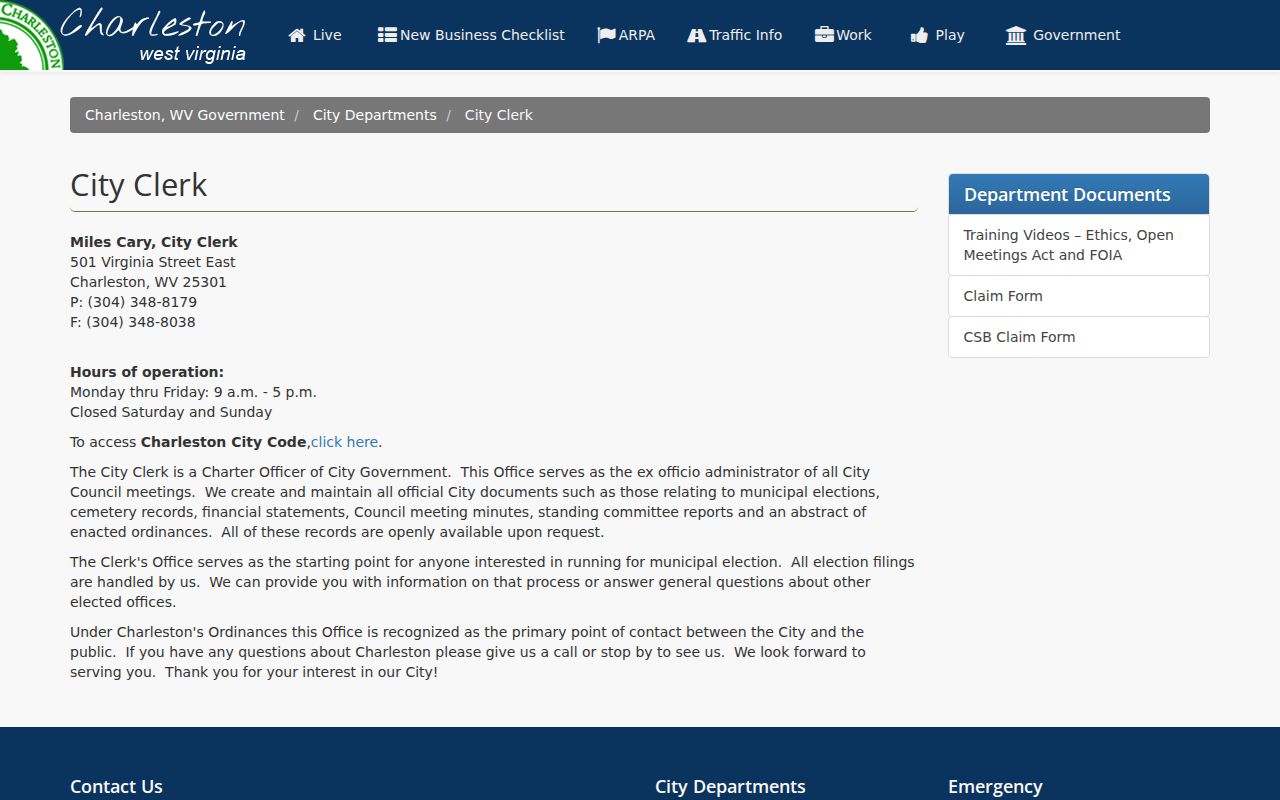
West Virginia municipal sources add details the state portals do not collect in one place. Charleston's City Clerk handles municipal election records, cemetery records, council minutes, committee reports, financial statements, and ordinance abstracts. The city's departments also route requests about permits, address assignments, annexation, code issues, cemetery records, and municipal court. These are examples of local practice, not a substitute for checking the city that holds a West Virginia record.
The Charleston City Clerk page lists its public office and request route in West Virginia. The screenshot below shows that office's records page, where municipal records and contact information are grouped.
For a building permit, Charleston publishes permit classes but no public searchable case index or field list was located. Give the Building Department the street address, parcel or owner if known, work type, and approximate year; ask the custodian about copies and delivery. A specific request to the city department can use the West Virginia Freedom of Information Act.
West Virginia Heir Records and Unclaimed Property
An heir tracing a West Virginia relative can search the State Treasurer's West Virginia Unclaimed Property portal by name, city, and state. A match may point to property held for an owner, but it is not proof of current residence or a family relationship. The claim process asks for its own supporting documents; use the official Treasurer route rather than a mailer asking for an advance fee.
A West Virginia result is only a lead. Claim records have privacy controls, and a claimant must meet the Treasurer's document requirements before property is released. An obituary or probate record may help establish a family link; the County Clerk or court custodian can verify a deed or estate filing.
West Virginia Resident Searches Differ in Depth
A West Virginia portal can be public without showing the whole file. Compare what each route returns before you decide whether a web result is enough. For personal research in West Virginia, an official index gives a traceable starting point; a commercial directory may blend records from different dates and sources and can charge for a report. Neither replaces the original custodian's copy.
| Official record route | Commercial directory category |
|---|---|
| Names a custodian, county, record class, and coverage limit. | May combine data from different offices and collection dates. |
| Can lead to a free status check, index, or public docket; some images or copies cost money. | May charge for access; the source and update date can be less clear. |
| The responsible office can confirm, correct, or certify its record. | Only the source office can resolve a record mismatch. |
West Virginia Resident Searches Protect Some Addresses
West Virginia's Address Confidentiality Program gives qualifying survivors of domestic violence, sexual assault, stalking, and human trafficking a substitute address and free first-class mail forwarding. The Secretary of State runs the program under W. Va. Code §48-28A; certification lasts four years. Participants apply through an approved application assistant, and state or local agencies and courts accept the substitute address subject to statutory exceptions.
Other West Virginia records have their own limits. Voter data withholds phone, email, Social Security number, and driver's-license or state-ID numbers. Court records can be sealed, expunged, or confidential. The DMV's address information is restricted under the federal Driver's Privacy Protection Act. Public access to a parcel or deed does not make every household member, telephone number, or protected address public.
Use records for lawful personal research. Do not combine public details to stalk, harass, threaten, or harm another person. If a record concerns a protected person, follow the custodian's redaction and confidentiality rules.
West Virginia Records Requests
The West Virginia Freedom of Information Act, W. Va. Code §29B-1-1 et seq., applies to records kept by public bodies. In West Virginia, send a reasonably specific written request to the office that maintains the item. Name the county, record type, person or parcel, date range, and format; for a deed or court file, include any instrument or case number already found.
Within five days, excluding weekends and legal holidays, a West Virginia custodian must provide copies, set a time and place for inspection, or deny the request in writing with reasons. A fee may cover actual reproduction costs, but the law does not allow search or retrieval labor charges under §29B-1-3. The West Virginia Secretary of State's FOIA guide explains the route, but the request itself goes to the office holding the record. For county files, use the County Clerk directory or the appropriate circuit clerk, assessor, sheriff, or commission office.
Historical West Virginia Resident Directories
Old West Virginia city and telephone directories can put a name at a dated address when current rolls cannot answer a family-history question. The West Virginia State Archives lists Charleston volumes beginning in 1874 and a Wheeling volume from 1851, among many town runs with gaps. WVU's microfilm adds later runs, while Kanawha County Public Library keeps Polk's Charleston and suburban volumes from 1908 to the present for in-library use on its third floor. The full collection map and entry-reading notes are in the West Virginia city directory collections.
For a West Virginia address, use the town or regional telephone exchange as well as a city name, since rural communities can appear in a neighboring exchange. A directory entry offers a dated residence and often an occupation or household notation; it does not prove ownership or uninterrupted occupancy. Pair it with a deed, census, obituary, or vital record before treating two same-name entries as one person.
West Virginia Records Follow Old County Lines
West Virginia became a state on June 20, 1863, but a person who lived here before statehood may appear in a Virginia county record. Begin with the county that held jurisdiction on the event date, not only the present state name. County formation also changes the search: Mercer began in 1837, McDowell in 1858, and Mingo in 1895, so an earlier event may be filed under a parent county.
West Virginia record loss is local rather than statewide. Mercer courthouses burned in 1862 and 1870, yet microfilm reaches back to the county's formation and much survived. Morgan County's 1844 fire and Civil War losses left births and deaths before 1865 missing. A gap in one index does not prove that a family or deed never existed; ask the West Virginia State Archives or county custodian which related books, films, or neighboring-county records survive.
West Virginia's record systems still reflect that county history. County clerks and assessors keep the core files, while state portals offer search layers over some of them. Keep the event year, place name, and jurisdiction with every lookup so the next custodian can check the right record series.